The road north out of Tbilisi has exactly one job: get you over the Greater Caucasus. Engineers cut the modern version of it into the gorge walls in 1799 and called it the Georgian Military Road, but the route is far older than that name, and it has been carrying merchants, armies, pilgrims and complaining Russian poets across the mountains for centuries.
You will cover 157 kilometres of it today, and the country changes underneath you roughly four times on the way. Vineyard-and-orchard flatland gives way to the deep green of the Aragvi valley, then to bare alpine grass above the treeline, then — after the pass — to something drier and harder-edged, with the border a few kilometres further on. It is one of the few day trips anywhere that genuinely feels like crossing into a different country by lunchtime.
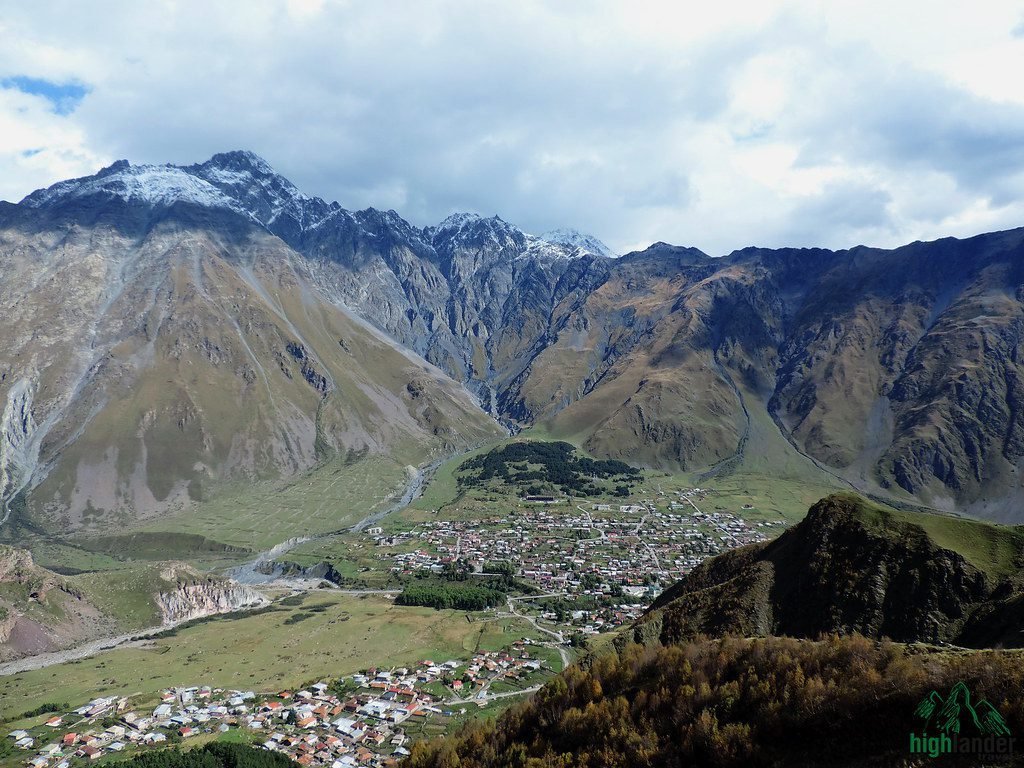
The day is built around four fixed points: the turquoise reservoir at Zhinvali, the Ananuri fortress on its shoreline, the Cross Pass at 2,395 metres, and Gergeti Trinity Church, standing at 2,170 metres above the village of Stepantsminda with Mount Kazbek behind it. A 4×4 takes you the last stretch up to the church — the track is steep, unpaved and not something a normal car should attempt.
One honest note before you book: Kazbek is 5,047 metres high and it makes its own weather. Some days it stands there completely clear and the whole valley stops to look at it. Other days the cloud never lifts and you photograph a beautiful church in front of a wall of white. Nobody can promise you which day you will get. What we can promise is the road, the pacing, and a driver-guide who knows where to stop when the light is good.
This is a private tour, which means your group travels alone, the departure time is yours, and if you want twenty more minutes at Ananuri because the light on the Aragvi is doing something remarkable, you get them.
What you’ll see
Tour highlights
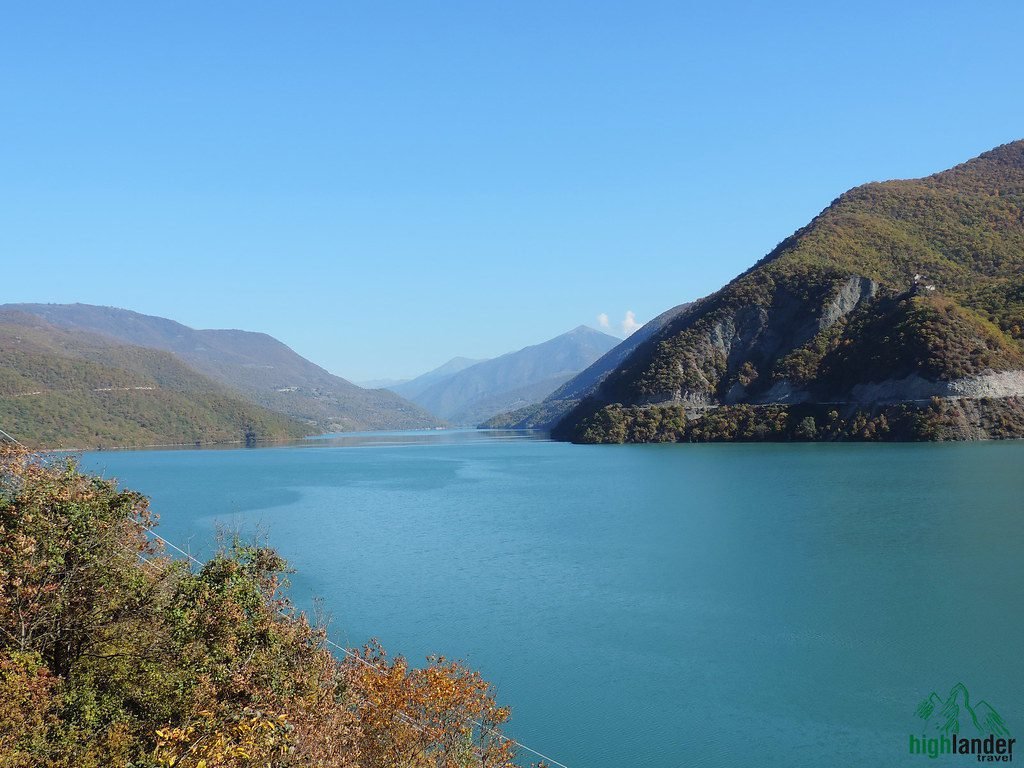
- Zhinvali Reservoir — the water sits somewhere between jade and petrol blue depending on the season, held back by a 102-metre dam finished in 1985. It supplies most of Tbilisi’s drinking water, which explains why nobody is swimming in it.
- Ananuri fortress — the seat of the Aragvi dukes, with curtain walls dropping straight to the shoreline. The Church of the Assumption inside has a carved grapevine cross on its south wall, one of the finest pieces of stone carving in the country.
- The Gudauri panorama — a curved concrete drum built in 1983 for the bicentenary of the Treaty of Georgievsk, covered inside with a mosaic mural. It hangs over a 400-metre drop into the Aragvi gorge, which is really why people stop.
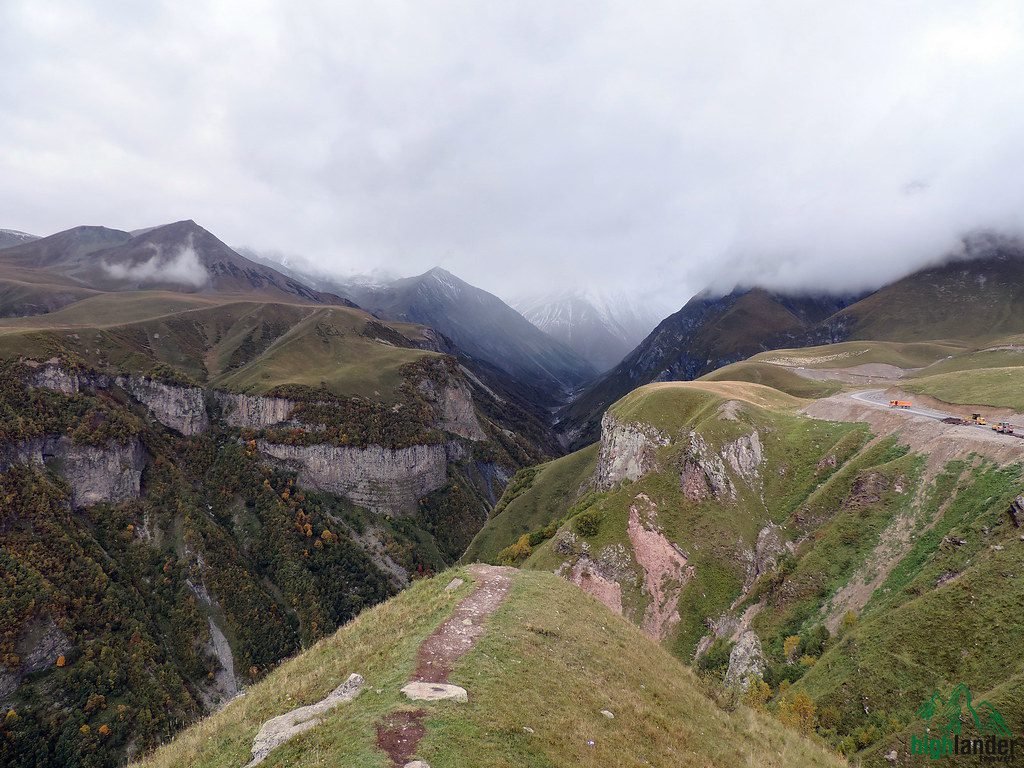
- The Cross Pass, 2,395 m — the high point of the Georgian Military Road, marked by a stone cross and, in early summer, snowbanks still standing beside the tarmac.
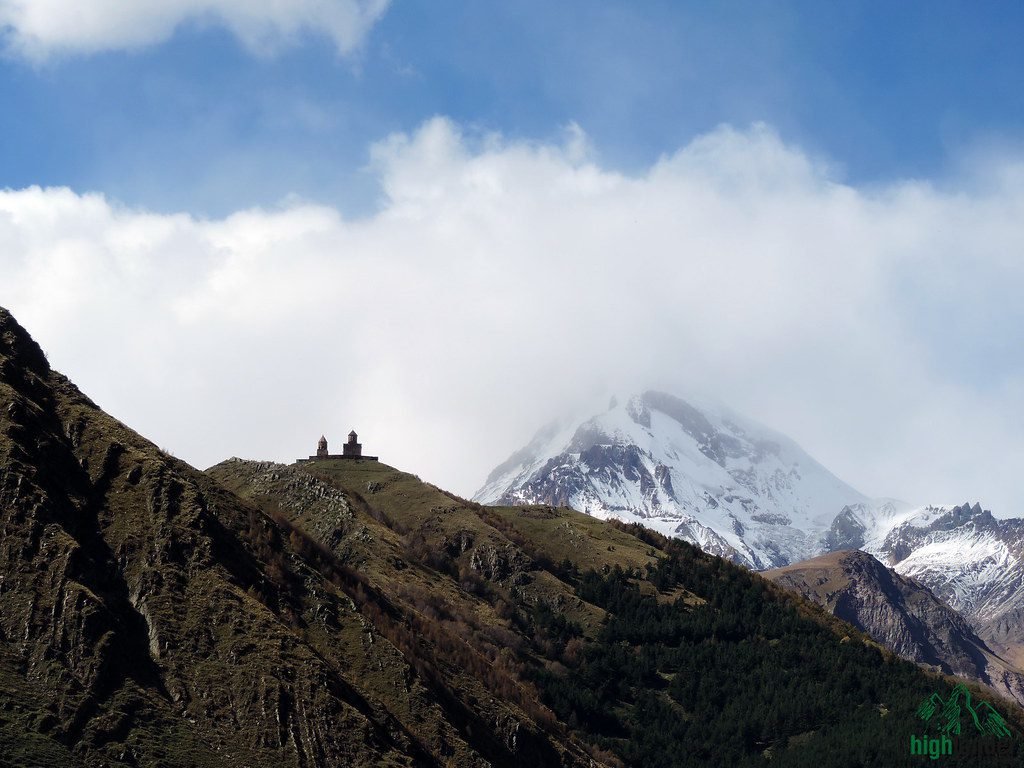
- Gergeti Trinity Church — 14th century, single-nave, no electricity, reached by 4×4 up a track that switchbacks through pine forest. Villagers hid Tbilisi’s treasures here whenever an invasion came over the pass.
- Mount Kazbek, 5,047 m — the extinct volcano the Greeks chained Prometheus to. On a clear day it fills the frame behind the church.
- Dariali Gorge and Gveleti Waterfall — a 20-minute walk from the road brings you to a 25-metre fall in a side canyon, three kilometres from the Russian border.
- A private car and a driver-guide, not a 20-seat bus — you set the departure time, and you stop where you want to stop.
Step by step
Tour itinerary
Times are indicative. It is a long day — roughly eleven to twelve hours door to door — and the schedule flexes with weather, traffic and how long you want to stand around taking photographs.
08:00 — Pickup in Tbilisi
Your driver-guide collects you from your hotel or apartment. Earlier starts are possible and often a good idea in July and August, when the Gergeti track gets busy by midday.
09:15 — Zhinvali Reservoir
The first stop, about seventy kilometres out. A short viewpoint halt above the water, where the drowned valley of the Aragvi opens up below the road. Fifteen minutes, mostly for photographs.
09:40 — Ananuri fortress
A proper stop, about forty minutes. You can walk the walls, climb into the Sheupovari tower where the last defenders held out in 1739, and go inside both churches. Look for the carved grapevine cross and the depiction of the Ascension above the south door — the carving is late 17th century and remarkably intact.
11:15 — Gudauri and the Russia–Georgia Friendship Monument
The road climbs hard past Pasanauri, where the black and white branches of the Aragvi meet and run side by side for a while without mixing. At Gudauri you stop at the mosaic viewpoint above the gorge. Half an hour, longer if paragliders are launching.
12:00 — The Cross Pass
A brief photo stop at 2,395 metres, the watershed of the Greater Caucasus. There is a mineral spring nearby that has stained the whole hillside rust-orange — worth the two-minute walk.
13:15 — Stepantsminda and Gergeti Trinity Church
You arrive in the valley town of Stepantsminda, transfer to a local 4×4, and grind up the track to the church at 2,170 metres. Allow about ninety minutes for the transfer, the church itself and the walk around the ridge behind it, which is where the best views of Kazbek are. Shoulders and knees must be covered; women are given a wrap and a headscarf at the door if needed.
15:15 — Lunch in Stepantsminda
An hour in a family-run restaurant in the town. This is mountain food: khinkali the size of a fist, lamb, mushrooms cooked in a clay ketsi dish, and the local cheese-and-potato bread. Lunch is not included in the price, which keeps you free to choose.
16:30 — Dariali Gorge and Gveleti Waterfall
Twelve kilometres north towards the Russian border, the valley narrows into a granite corridor barely wide enough for the river and the road. From the parking area a rocky path leads twenty to twenty-five minutes up a side canyon to the Gveleti falls. The walk is easy but uneven — trainers are fine, sandals are not. The path is usually clear from late May onwards.
Alternative — Sno Valley
If the waterfall path is under snow, or if you would rather skip the walk, we drive into the Sno valley instead: a medieval tower, a river the colour of milk, and seven oversized stone heads carved by a local sculptor, staring at each other across a meadow. It is a strange and quiet place, and it photographs beautifully.
17:30 — The road back
Three hours south, with one coffee stop. Expect to be back in Tbilisi between 19:30 and 20:30 depending on traffic at the city edge.
Starting from
€135
per person
Locally operated since 2011
We reply within 24 hours
What your price covers
What’s included
Included
- Private air-conditioned vehicle for your group only — sedan, minivan or minibus depending on numbers
- English-speaking driver-guide for the full day
- Hotel or apartment pickup and drop-off anywhere in central Tbilisi
- Fuel, road tolls and all parking fees
- 4×4 transfer from Stepantsminda up to Gergeti Trinity Church and back
- Bottled water in the car
- All taxes and booking fees — the price you see is the price you pay
Not included
- Lunch and drinks — budget 25–50 GEL per person in Stepantsminda
- A licensed art-history guide, if you want in-depth commentary inside the churches (available on request, quoted separately)
- Horse riding, paragliding at Gudauri, and any other optional activity
- Travel insurance
- Tips for your driver-guide — appreciated, never expected
- Personal expenses and souvenirs
Photographs
Gallery
Where you’ll go
Map & route
Tbilisi
Practical details
Good to know before you go
What to bring
- A warm layer, whatever the forecast says. Tbilisi can be 32°C while the Cross Pass sits at 8°C with wind. The temperature difference between the two ends of this road is the single thing most visitors underestimate.
- Closed shoes with grip. The ridge behind Gergeti and the Gveleti path are both uneven and often wet.
- Something to cover shoulders and knees for the churches. Wraps and headscarves are lent at the Gergeti entrance, but bringing your own is more comfortable.
- Sunglasses and sunscreen. At 2,400 metres the sun is considerably stronger than it feels.
- Cash in lari. Card payment works in Stepantsminda restaurants but not always at small kiosks or for the horses.
Altitude and fitness
Nothing on this tour requires more than ordinary fitness. The highest point you reach is 2,395 metres at the pass, and you stay there for minutes, not hours — altitude sickness is very unlikely. The church sits at 2,170 metres and the 4×4 takes you almost to the door. If you would rather not walk at all, you can stay at the church terrace while the rest of your group climbs the ridge.
Weather and road conditions
The Georgian Military Road is officially open year-round, but the Gudauri–Kobi section can close for a few hours at a time during winter avalanche control, and heavy snow occasionally closes it for a day. We check the road authority’s status every morning before departure. Between December and March, snow chains and a competent winter driver are not optional extras — they are the reason to book a driver rather than rent a car.
Best time to go
| Season | What it looks like | Worth knowing |
|---|---|---|
| April – mid-May | Green valleys below, deep snow still on the pass and around the church | Gveleti path often blocked; Sno valley replaces it |
| Late May – June | Wildflowers on the alpine meadows, snowmelt in the rivers, long light | The best combination of clear skies and empty roads |
| July – August | Warm and busy; afternoon cloud builds around Kazbek most days | Start at 07:00 to reach Gergeti before the crowds |
| September – October | Clearest air of the year, autumn colour in the gorges | Statistically the best month for actually seeing the summit |
| November – March | Snow-covered, spectacular, occasionally severe | Shorter daylight means the waterfall stop is usually dropped |
Travelling with children
Families do this trip regularly. The driving stretches are long — about three hours each way — so bring something to occupy younger children between stops. Child seats are available free of charge if you tell us the ages when you book.
Booking and cancellation
Book at least 24 hours ahead so we can confirm the vehicle and the 4×4. Free cancellation up to 24 hours before departure. If the road is closed by the authorities on your date, you can move the tour to another day or take a full refund — we do not run it in unsafe conditions.
From our travellers
Reviews
Before you book
Frequently asked questions
How long is the Kazbegi tour from Tbilisi?
Around eleven to twelve hours door to door. Stepantsminda is 157 kilometres from Tbilisi and the drive takes about three hours each way, which leaves roughly five hours for the stops. Most groups leave at 08:00 and are back between 19:30 and 20:30.
What is the best time of year to visit Kazbegi?
Late May to early October gives you the fullest version of the tour, including the Gveleti waterfall walk. September and early October have the clearest air, so if seeing Mount Kazbek without cloud matters to you, come then. April and early May are beautiful but the high ground is still under snow, and the waterfall path is usually closed.
Can I do this tour in winter?
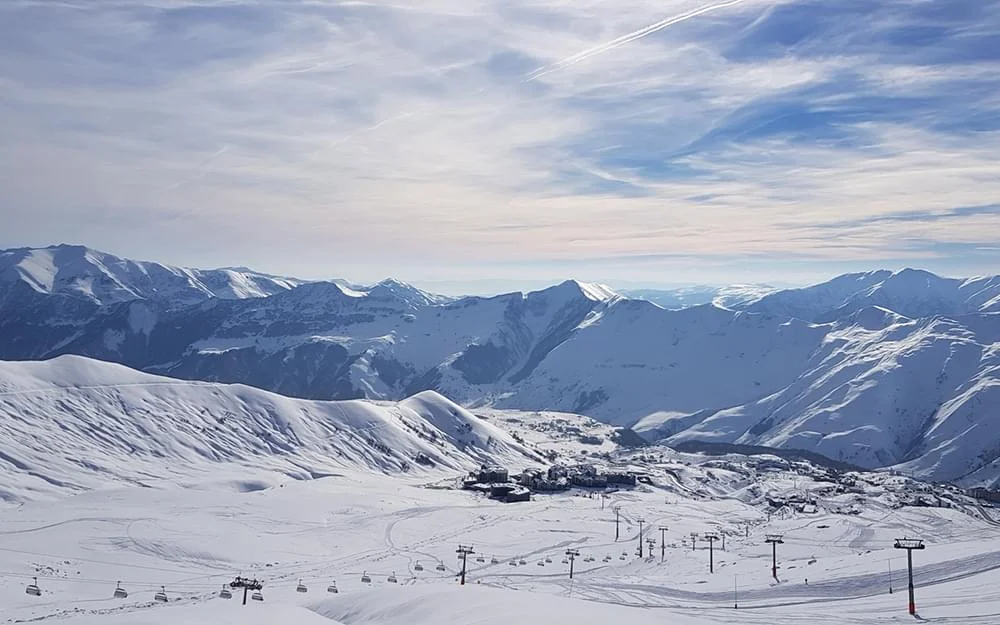
Yes, and it is a completely different trip — white valleys, frozen waterfalls, Gudauri full of skiers. Two caveats: daylight is short, so the itinerary is trimmed, and the Gudauri–Kobi section of the road can close for a few hours during avalanche control. We check road status every morning and will reschedule or refund if it is not safe.
Do I have to hike to Gergeti Trinity Church?
No. A 4×4 transfer up to the church is included in your price, and the drive takes about twenty minutes on a steep unpaved track. If you would rather walk, the trail from Stepantsminda takes ninety minutes to two hours uphill and gains around 400 metres — tell your driver-guide in the morning and we will build the time in.
Is there a dress code at the churches?
Shoulders and knees covered for everyone; women are asked to wear a skirt and a headscarf inside. Wraps and scarves are provided free at the entrance to Gergeti and Ananuri, so nobody gets turned away — but bringing your own is easier.
Will I actually see Mount Kazbek?
Sometimes. The mountain is 5,047 metres high and generates its own cloud, and in midsummer that cloud tends to build through the afternoon. An early start improves your chances considerably. Roughly speaking, autumn mornings are your best odds and August afternoons your worst. No operator can guarantee it, and any that does is guessing.
Is the tour private or shared?
Private. You travel with your own group, your own driver-guide and your own vehicle, and the pace is yours. The per-person price falls as the group grows because the cost of the car is shared between more people.
Is lunch included?
No, deliberately. Your driver-guide takes you to a family-run restaurant in Stepantsminda where a full meal runs about 25–50 GEL per person, and you order what you want rather than eating a fixed set menu. Vegetarian, vegan and halal options are all available if you mention it when booking.
Do you pick up from my hotel?
Yes — anywhere in central Tbilisi at no extra cost. Pickups from the airport, from Mtskheta or from outlying districts can be arranged; just tell us the address when you book.
Is the tour suitable for elderly travellers or people with limited mobility?
Largely yes. The car takes you to every viewpoint and the 4×4 goes almost to the church door. Ananuri has some uneven steps, and the waterfall walk can be skipped without losing much of the day. Tell us in advance and we will plan the stops around what works for you.
Ready when you are
Tell us your dates and how many of you are travelling. We’ll come back within 24 hours with availability, a confirmed price, and your guide’s name.