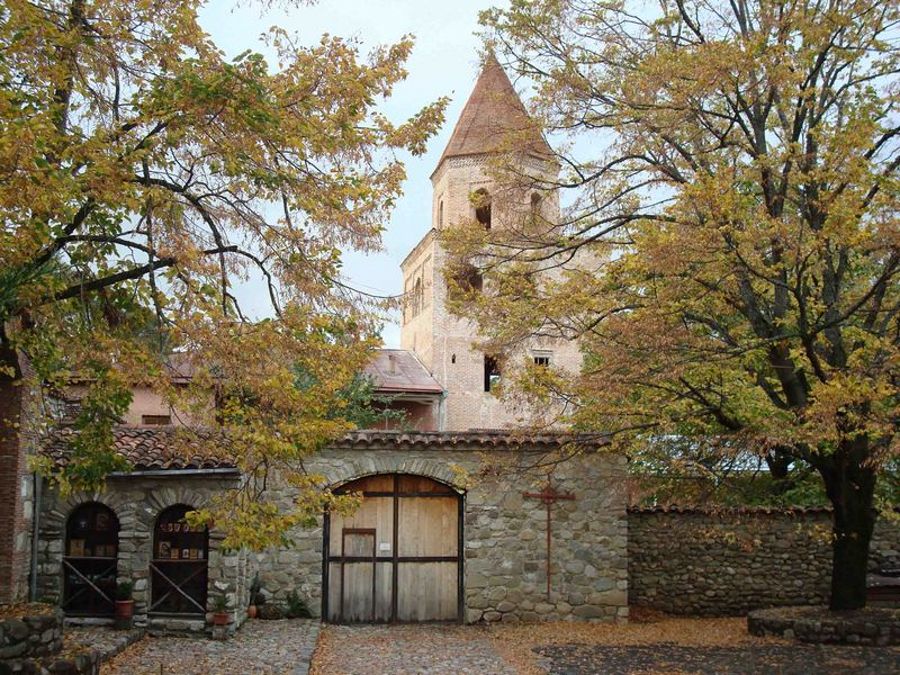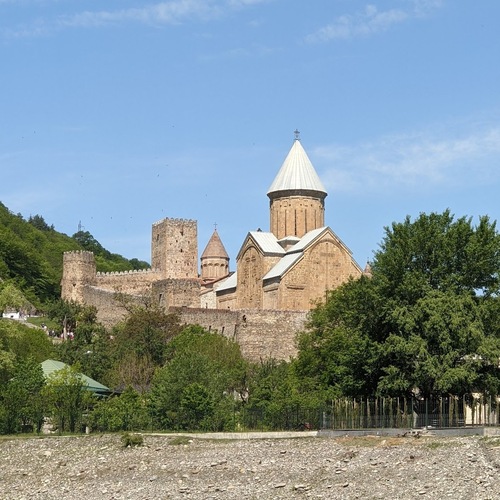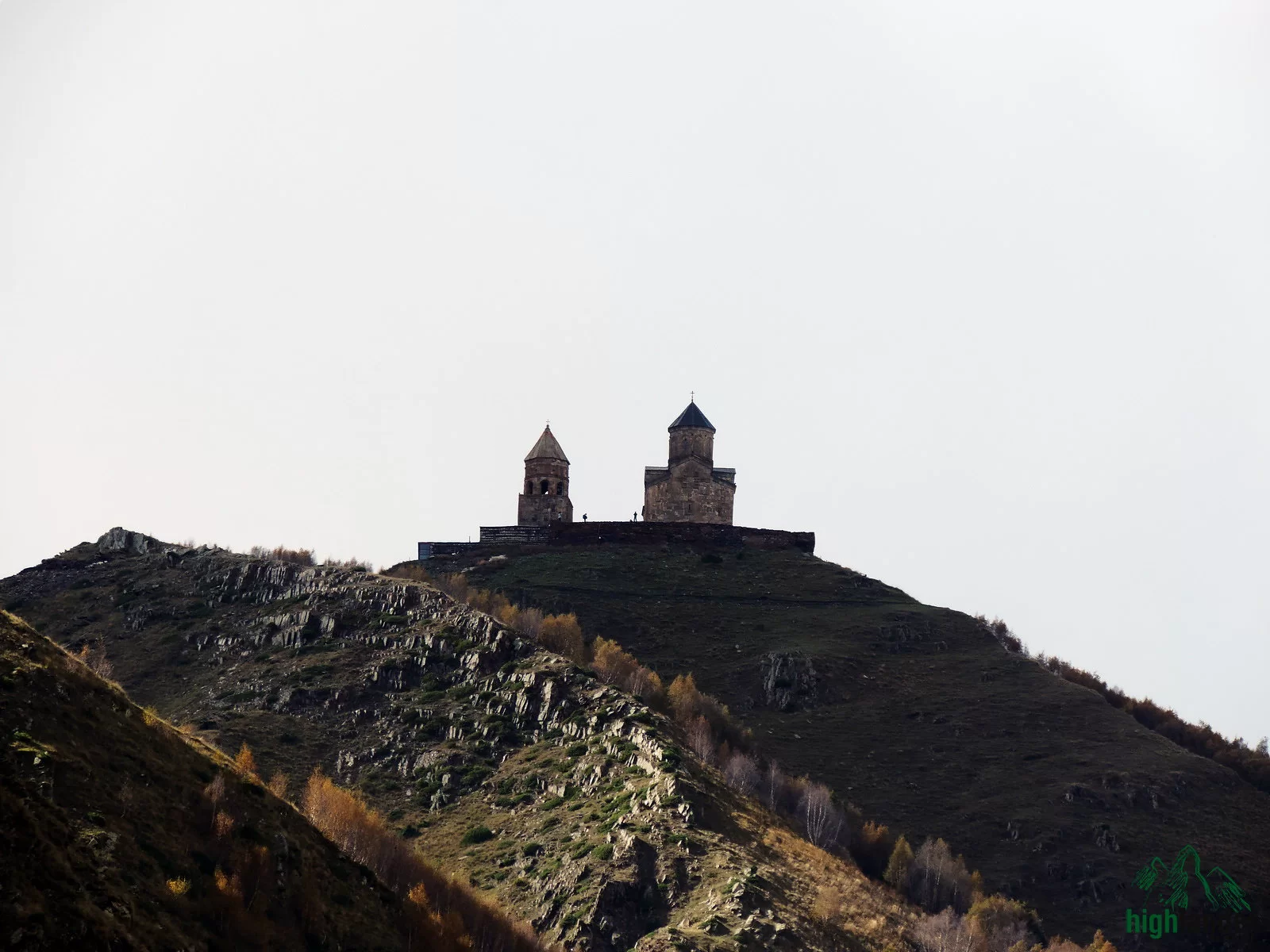
Ikalto monastery
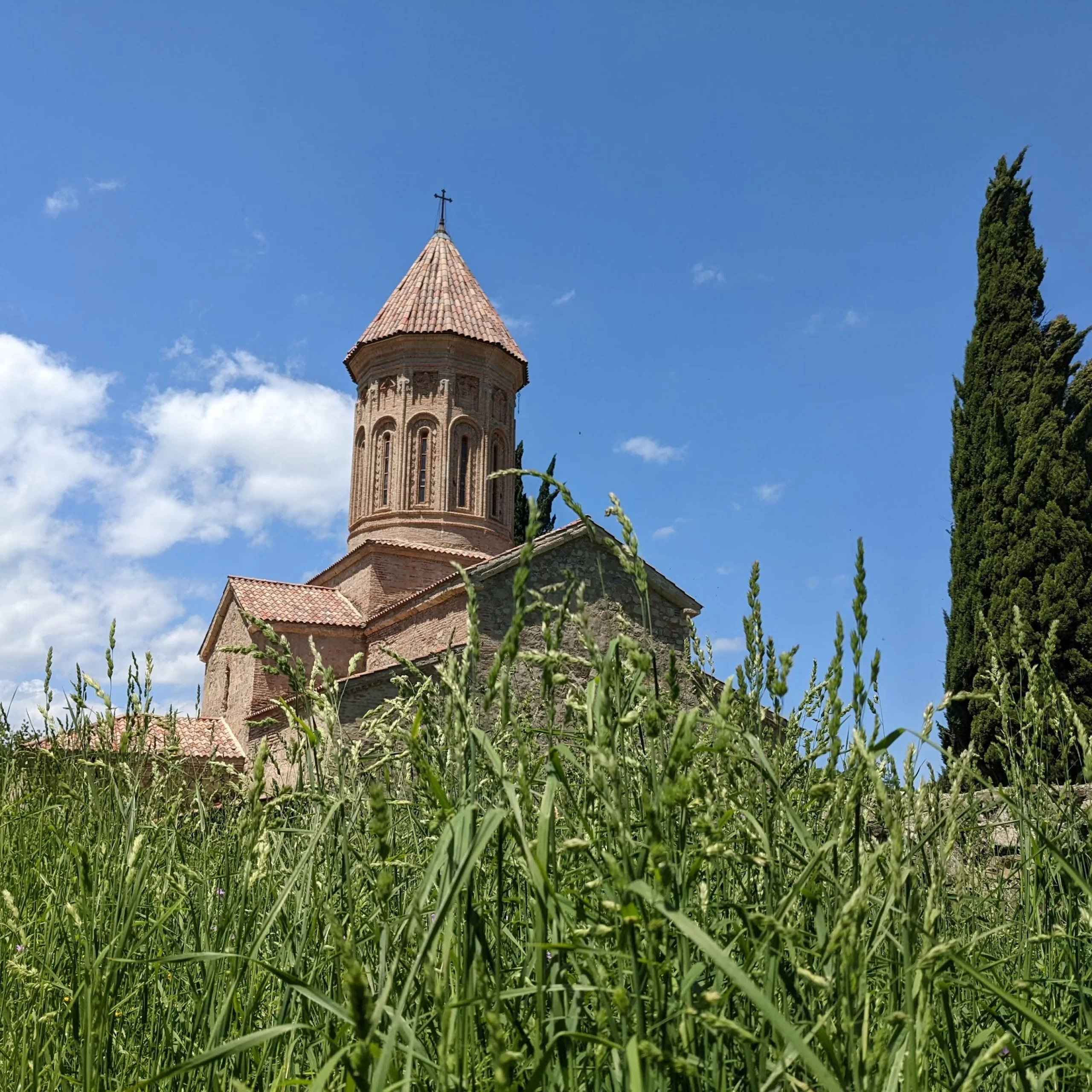
In the hills of Kakheti, a 6th-century monastery became home to one of the oldest universities in the Christian world — a place where monks studied theology, philosophy, and the sacred art of Georgian winemaking.
Every Georgian knows the name Shota Rustaveli. His epic poem “The Knight in the Panther’s Skin” is the cornerstone of Georgian literature, a national treasure recited at weddings and quoted in daily conversation. What few visitors realize is that you can stand in the ruins of the academy where Rustaveli studied, walk among the stone foundations where medieval scholars debated philosophy, and see the ancient qvevri – clay wine vessels – that remind us this was a place where wine was not just consumed but taught as a sacred craft.
This is Ikalto, one of Kakheti’s most historically significant sites and a place where Georgia’s parallel passions for faith, learning, and wine intersect in the same weathered stones.
Why Ikalto Matters
Ikalto offers something rare among Georgia’s many monasteries: the tangible remains of a great medieval center of learning. While churches and fortresses dot the Georgian landscape, actual academy buildings from the 11th and 12th centuries are exceptionally scarce. At Ikalto, you can walk through the ruined halls where students once studied — the same halls that shaped the mind of Georgia’s most celebrated writer.
Key facts:
- Founded: 6th century (monastery), Academy established in the late 11th century
- Location: Kakheti region, 8 kilometers west of Telavi
- Founder: Saint Zenon, one of the Thirteen Assyrian Fathers
- Famous student: Shota Rustaveli (c. 1160–1220)
- UNESCO status: Part of the Tentative List for World Heritage Sites
- Current status: Active monastery with resident monks
The History of Ikalto
Foundation by Saint Zenon (6th Century)
Ikalto’s story begins in the 6th century when Saint Zenon, one of the Thirteen Assyrian Fathers who brought monasticism to Georgia, established a monastic community in the forested hills above the Alazani Valley. These Syrian missionaries founded monasteries across Georgia that became centers of Christian learning and culture — Ikalto among the most important.
The original monastery was modest, focused on prayer and simple monastic life. The small Church of the Holy Trinity (Sameba) dates from this earliest period, though centuries of reconstruction have altered its appearance. Built of local cobblestone with a characteristic deep apse, this intimate church remains the spiritual heart of the complex.
The Golden Age: Ikalto Academy (11th–12th Centuries)
Ikalto’s transformation from quiet monastery to intellectual powerhouse came under King David IV (David the Builder), whose reign (1089–1125) marked a golden age for Georgian culture. Around this time, Ikalto Academy was established, quickly becoming one of the most important educational institutions in the Caucasus.
The academy offered instruction in theology, philosophy, astronomy, geography, geometry, and rhetoric. But it also taught something distinctly Georgian: winemaking. In a region where wine has religious, cultural, and economic significance stretching back 8,000 years, the inclusion of viticulture in the curriculum made perfect sense. The monks of Ikalto saw no contradiction between contemplating the divine and perfecting the craft of qvevri fermentation.
At its height, Ikalto Academy rivaled the famous Gelati Academy near Kutaisi as the leading center of learning in Georgia.
Shota Rustaveli: The Academy’s Most Famous Student
Sometime in the late 12th century, a young man named Shota arrived at Ikalto to study. He would become Shota Rustaveli, the author of “Vepkhistkaosani” (The Knight in the Panther’s Skin), an epic poem of approximately 6,000 lines that remains the supreme achievement of Georgian literature.
Rustaveli’s masterwork explores themes of friendship, love, loyalty, and the ideal of knightly virtue. Its influence on Georgian culture cannot be overstated — lines from the poem are woven into the fabric of daily Georgian life, and the text has been translated into dozens of languages.
Walking through Ikalto’s academy ruins, knowing that Rustaveli absorbed his education within these walls, adds a profound dimension to the visit. The poetic genius that produced Georgia’s greatest literary work was shaped here, in these stone halls overlooking the vineyards of Kakheti.
Destruction and Survival
Like many Georgian monuments, Ikalto suffered during periods of invasion. Shah Abbas I’s Persian forces devastated the complex in 1616, and the academy never fully recovered its former prominence. The monastery continued functioning, but the great center of learning had ended.
What survived includes the three churches, portions of the academy building, the refectory ruins, and — remarkably — the qvevri embedded in the ground where students learned winemaking centuries ago. Though roofless and weathered, enough remains to evoke the scope of what once existed.
What to See at Ikalto
The Academy Ruins
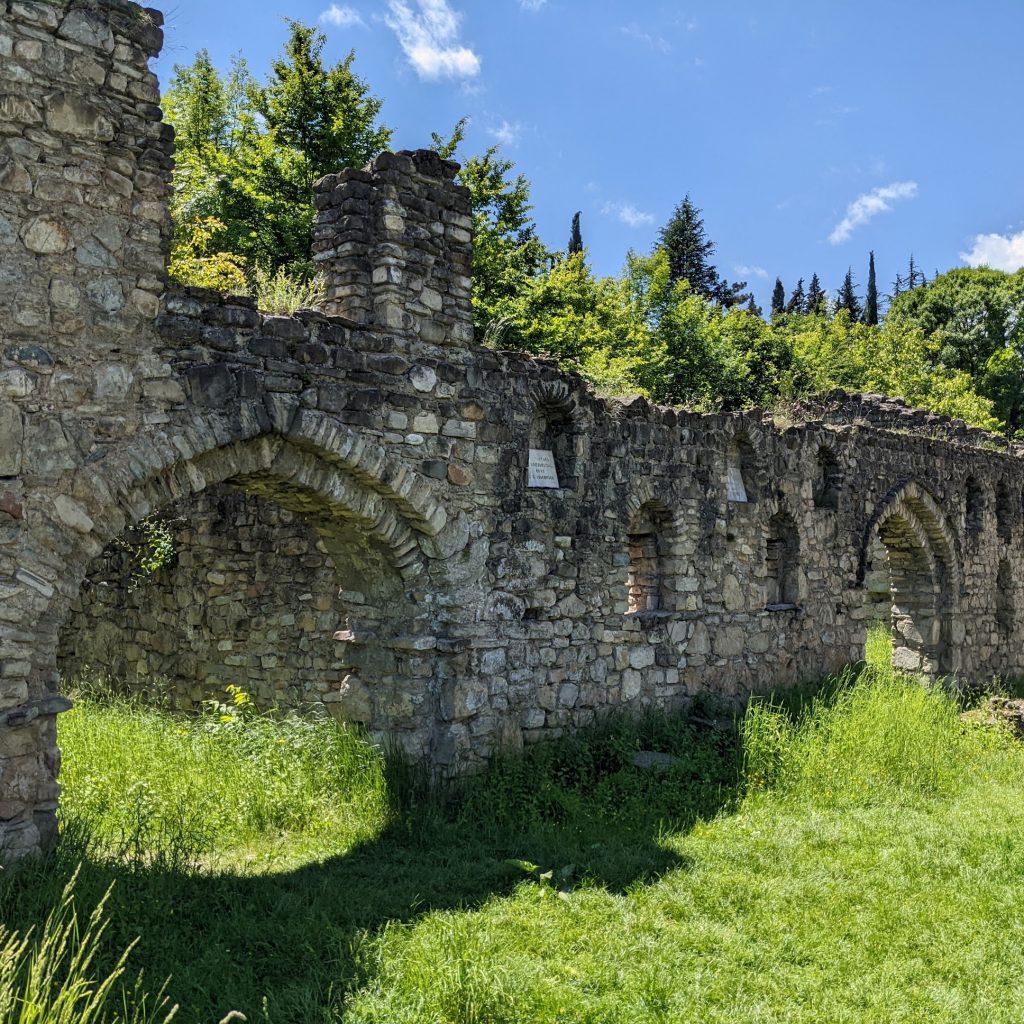
The most historically significant structure is the ruined academy building south of the main churches. Its stone walls, now open to the sky, outline lecture halls, workrooms, and gathering spaces. The massive dimensions hint at the institution’s importance — this was no simple schoolhouse but a substantial complex designed for serious scholarship.
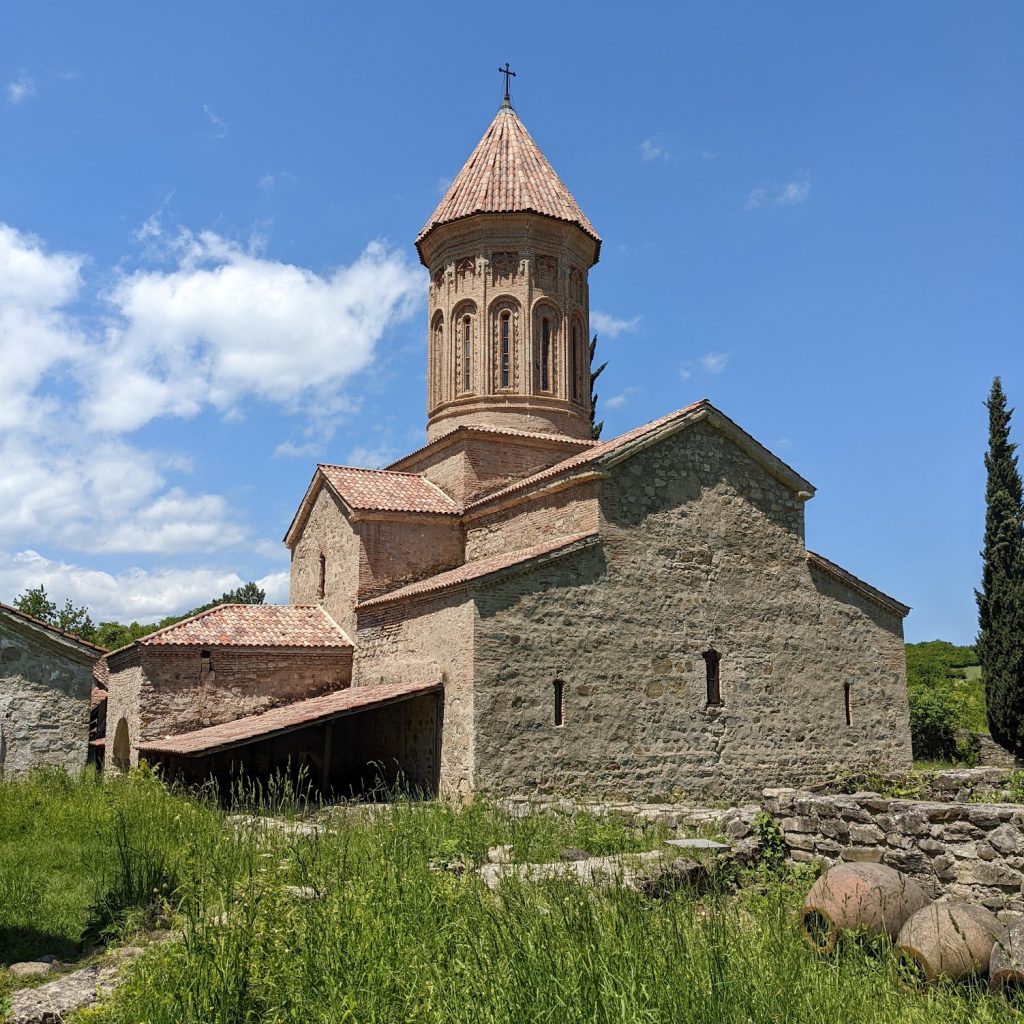
The qvevri: Most evocatively, you can see ancient qvevri — large clay vessels used for fermenting and storing wine — still embedded in the ground within the academy ruins. These are not decorative additions but original features, physical evidence that winemaking was part of the curriculum. For visitors interested in Georgia’s wine culture, this tangible connection between medieval education and viticulture is remarkable.
Church of the Transfiguration (Khvtaeba)
The main church of the complex, Khvtaeba (meaning “Divinity” or “Deity”), was built in the 8th–9th century over the tomb of Saint Zenon. This is a classic Georgian cross-in-square church with four interior columns supporting a central dome. The dome and upper portions were reconstructed in the 19th century using brick, altering the original proportions but preserving the building’s function.
Inside, modest frescoes and icons create an atmosphere of contemplative simplicity. The church remains active — monks celebrate liturgy here, and visitors may encounter services in progress.
Church of the Holy Trinity (Sameba)
The oldest surviving structure, the small Trinity church, dates to the 6th century founding period, though later reconstructions have modified its appearance. Its intimate scale and simple stone construction contrast with the larger main church, offering a glimpse of Ikalto’s earliest monastic life.
Refectory Ruins
Between the churches and the academy, the ruined refectory shows where monks took meals. Large stone halls with remnants of fireplaces speak to communal life in a functioning medieval monastery.
The Setting
Beyond the individual structures, Ikalto’s setting contributes to its atmosphere. The monastery occupies a ridge overlooking the Alazani Valley, surrounded by forest and, in the distance, the vineyards that define Kakheti. The peaceful, slightly overgrown grounds invite contemplation — this is not a polished tourist site but a working monastery where time seems to move slowly.
Visiting Ikalto: Practical Information
Location and How to Get There
Ikalto is located approximately 8 kilometers west of Telavi, the regional capital of Kakheti, and about 110 kilometers (2 hours) from Tbilisi.
From Telavi: The monastery is well-signposted on the road toward Akhmeta. A taxi from Telavi takes about 15 minutes and costs approximately 15–20 GEL. If you’re driving, the access road leads directly to a small parking area near the monastery entrance.
From Tbilisi: Ikalto is typically visited as part of a Kakheti day tour combining multiple sites, as reaching it by public transport requires changing vehicles in Telavi.
GPS coordinates: 41.9298° N, 45.3833° E
Opening Hours and Entrance
The monastery grounds are open daily from approximately 9:00 to 18:00 (later in summer). There is no entrance fee, though donations are welcomed.
As an active monastery, visitors should dress modestly. Women may need to cover their heads inside the churches (scarves are sometimes available at the entrance). Shorts and sleeveless tops are inappropriate for both men and women.
Time Needed
Most visitors spend 30–45 minutes exploring Ikalto. Those with particular interest in history, architecture, or photography may wish to allow an hour. The site is compact but rewards unhurried exploration.
Facilities
Facilities are minimal — a small parking area and occasionally a vendor selling candles or small souvenirs. There are no cafes or restrooms at the monastery itself. Plan accordingly, particularly if traveling with children.
Ikalto and Wine: The Connection
For travelers exploring Kakheti’s wine heritage, Ikalto adds historical depth to the experience. The qvevri visible in the academy ruins demonstrate that wine education has been part of Georgian learning for nearly a millennium.
This wasn’t monks making wine as a sideline — this was formal instruction in viticulture and winemaking as a legitimate academic subject alongside theology and philosophy. The Georgian Orthodox Church has always embraced wine as part of spiritual life, but at Ikalto, the cultivation of vines and the craft of qvevri fermentation were elevated to scholarly pursuits.
When you taste qvevri-aged wine at a Kakheti winery later in the day, remember that students at Ikalto were learning the same techniques in the same vessels nearly a thousand years ago.
Best Time to Visit
Ikalto is pleasant year-round, but certain seasons offer advantages:
Spring (April–May): The surrounding forests are lush, wildflowers bloom, and temperatures are comfortable for exploring.
Autumn (September–October): Kakheti’s grape harvest transforms the region. The vineyards surrounding Ikalto glow with fall colors, and the connection between the academy’s wine-teaching heritage and the living winemaking tradition feels especially vivid.
Summer: Warm to hot, but the monastery’s forested setting provides shade. Early morning or late afternoon visits are most comfortable.
Winter: Quieter and potentially atmospheric, though the setting lacks the greenery that enhances summer visits.
Combining Ikalto with Other Kakheti Sites
Ikalto’s location makes it an easy addition to any Kakheti itinerary. Nearby highlights include:
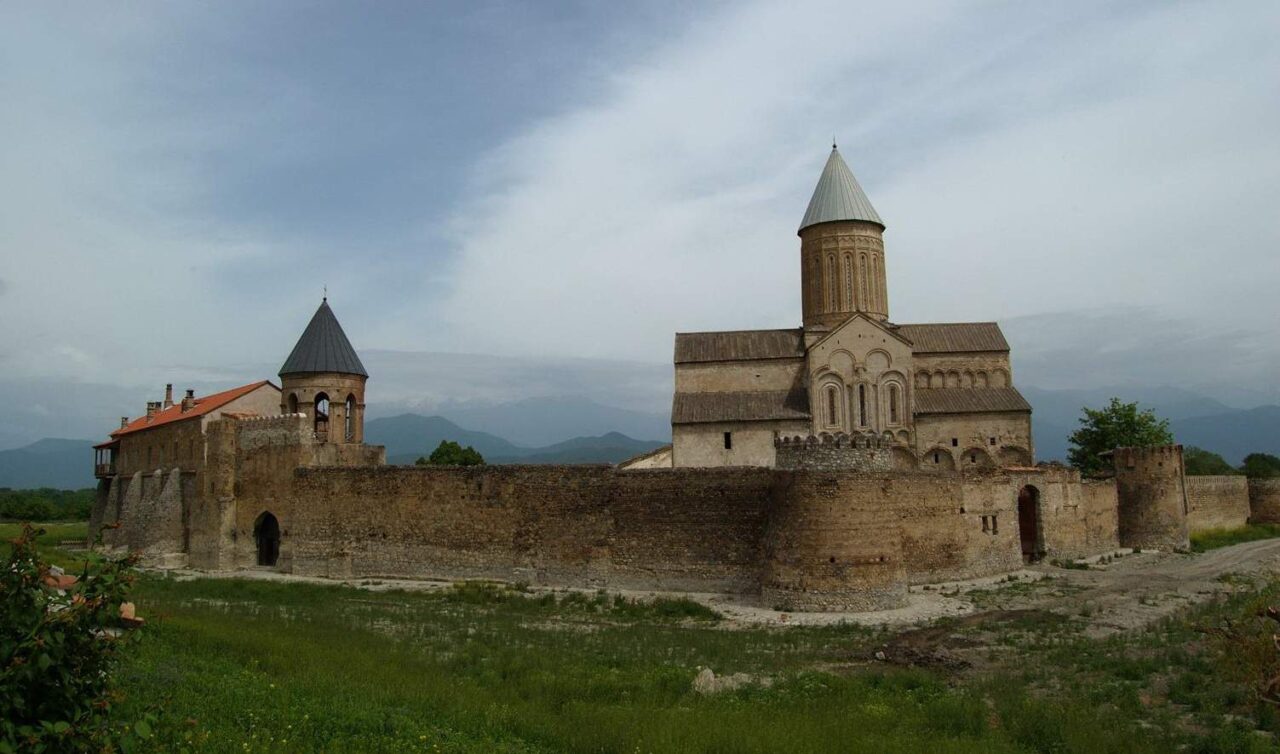
Alaverdi Cathedral (8 km): One of the tallest and most impressive churches in Georgia, dating to the 11th century. The cathedral is within easy reach and offers a powerful contrast — where Ikalto is intimate and academic, Alaverdi is monumental and awe-inspiring.
Telavi (8 km): Kakheti’s capital offers the 17th-century Batonis Tsikhe fortress, a famous 900-year-old plane tree, restaurants, and practical services.
Gremi (15 km): A picturesque 16th-century citadel and church complex perched on a hill — one of Kakheti’s most photogenic sites.
Tsinandali Estate (15 km): The historic estate of the Chavchavadze family, featuring a house museum, beautiful gardens, and a professional wine tasting facility.
Local wineries: Numerous family wineries and larger producers surround Ikalto, offering tastings of traditional qvevri wines.
Photography Tips
Ikalto’s atmospheric ruins and forested setting offer strong photographic opportunities:
- Golden hour light (early morning or late afternoon) illuminates the stone walls beautifully and creates long shadows in the academy ruins
- The qvevri make compelling subjects, especially with wide-angle lenses that capture their context within the ruined walls
- The monastery grounds are somewhat overgrown, which adds atmosphere — embrace rather than avoid the wild vegetation
- Interior photography in the churches may require permission and is often prohibited during services
- Drone usage may be restricted; check with monastery staff
Frequently Asked Questions
Where is Ikalto Monastery located?
Ikalto Monastery is located in the Kakheti region of eastern Georgia, approximately 8 kilometers west of Telavi and about 110 kilometers (2 hours) from Tbilisi.
Did Shota Rustaveli really study at Ikalto?
Yes. Historical sources indicate that Shota Rustaveli, author of “The Knight in the Panther’s Skin” and Georgia’s greatest poet, studied at Ikalto Academy in the late 12th century.
What was Ikalto Academy?
Ikalto Academy was one of the most important medieval educational institutions in Georgia, established in the late 11th century. It taught theology, philosophy, astronomy, rhetoric, and winemaking until its destruction in 1616.
Is there an entrance fee for Ikalto Monastery?
No. Entry is free, though donations are welcome.
What are the qvevri at Ikalto?
Qvevri are traditional Georgian clay vessels used for fermenting and aging wine. Ancient qvevri embedded in the ground at Ikalto Academy demonstrate that winemaking was formally taught there alongside academic subjects.
Is Ikalto an active monastery?
Yes. Monks reside at Ikalto, and the Church of the Transfiguration hosts regular Orthodox services.
How much time do I need to visit Ikalto?
Most visitors spend 30–45 minutes. Allow up to an hour if you have a particular interest in history or photography.
Can I visit Ikalto independently or do I need a tour?
Both options work. Independent visitors can reach Ikalto by taxi from Telavi. However, most travelers visit Ikalto as part of a guided Kakheti tour that combines multiple sites efficiently.
What should I wear to visit Ikalto?
Modest clothing is required at this active monastery. Women should cover their heads inside the churches, and both men and women should avoid shorts and sleeveless tops.
What other sites are near Ikalto?
Alaverdi Cathedral (8 km), Telavi (8 km), Gremi Citadel (15 km), and Tsinandali Estate (15 km) are all nearby. Numerous wineries surround the area.
Visit Ikalto on a Kakheti Tour
Ikalto reveals a Georgia beyond churches and fortresses — a Georgia of medieval scholarship, literary genius, and wine as a sacred craft. Standing in the ruins where Rustaveli studied, seeing the qvevri where monks taught winemaking, you encounter a culture that has valued learning and wine equally for a thousand years.
We include Ikalto in our Kakheti day tour, combining it with Alaverdi Cathedral, wine tastings, and the historic town of Sighnaghi. For deeper exploration, our extended Kakheti tours allow time for multiple wineries, villages, and hidden sites throughout Georgia’s premier wine region.
Georgia Tours has been exploring Kakheti with visitors since 2011. We know which wineries welcome guests, which back roads lead to hidden monasteries, and how to craft a day that balances history, wine, and authentic experiences. Contact us to plan your Kakheti journey.